Product Design
Eventbrite Boost
I designed the daily limit upgrade feature that converted 35% of existing and new free users to paid subscribers and contributed to $2.4M in revenue within the first three months of launch.
Year :
2021
Industry :
Events
Client :
Eventbrite
Project Duration :
3 months
Client
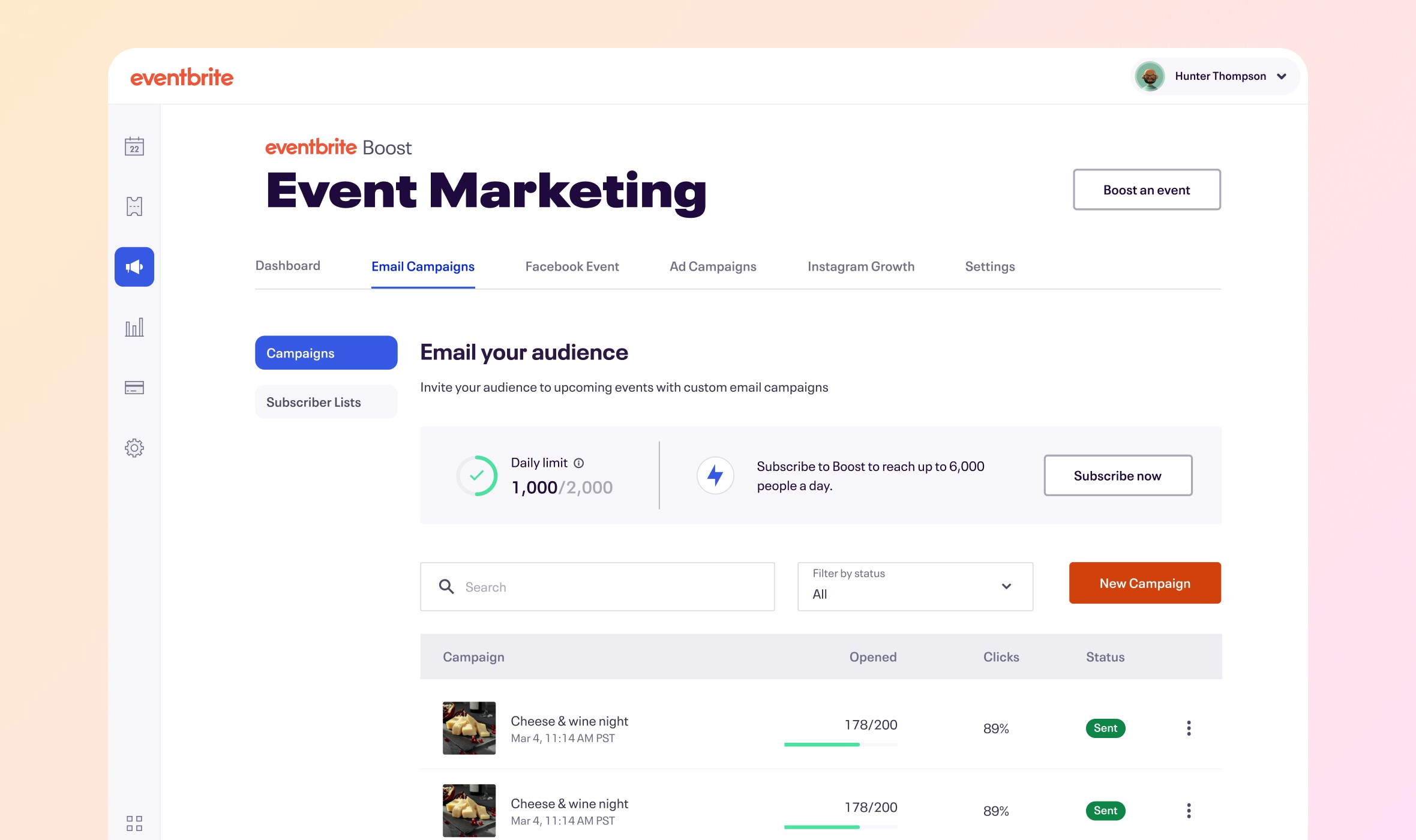
Eventbrite is a global ticketing and marketing platform for events processing millions of transactions annually. Boost was their marketing automation suite designed to turn event creators into effective marketers.
Challenge
Eventbrite Boost offered free email campaigns with a 2,000 emails-per-day limit. For event creators with small audiences, this was more than enough. But creators with larger databases—10,000, 20,000, even 26,000 contacts—constantly hit this ceiling.
These creators had two choices: manually chunk their campaigns into multiple 2,000-email batches over several days, or leave Eventbrite entirely and use Mailchimp or Constant Contact. Both options created friction. Manual chunking was tedious and error-prone. External tools meant exporting lists, managing multiple platforms, and losing the integrated experience Boost promised.
Here's the irony: Eventbrite was already giving away more for free than most competitors. Mailchimp had no daily limit for paid plans but charged from day one. HubSpot offered 5,000 emails. Sendinblue had unlimited daily sends but charged $25/month. Eventbrite gave 2,000/day for free—a generous offer—but nobody knew to appreciate it because it was invisible until you hit the limit.
The business problem was clear: free users weren't converting to Boost premium subscriptions. The email tool was valuable but didn't create enough perceived value to justify upgrading. Meanwhile, the most engaged users—those with large audiences who actually needed premium features—were the ones hitting friction and considering alternatives.
The opportunity: turn that friction point into a conversion moment.
Solution
In collaboration with the PM, we identified the daily limit as a strategic monetization opportunity. Users hitting the 2,000 email cap were signaling high engagement and real need—exactly the moment when upgrade offers convert best.
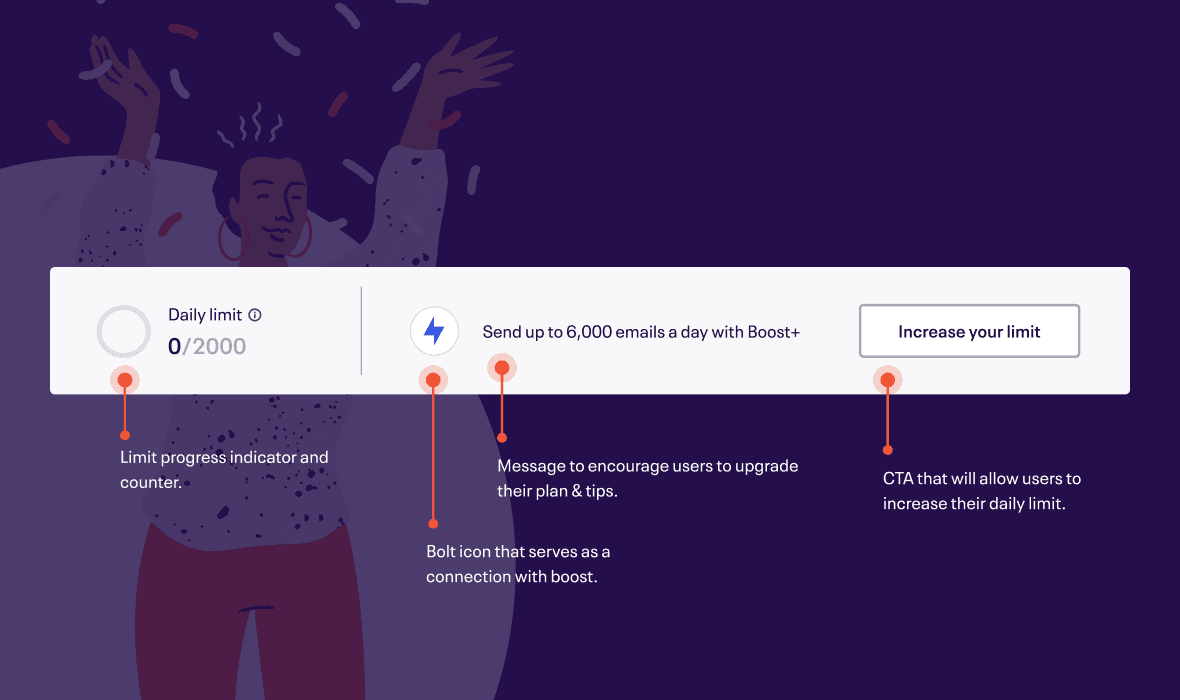
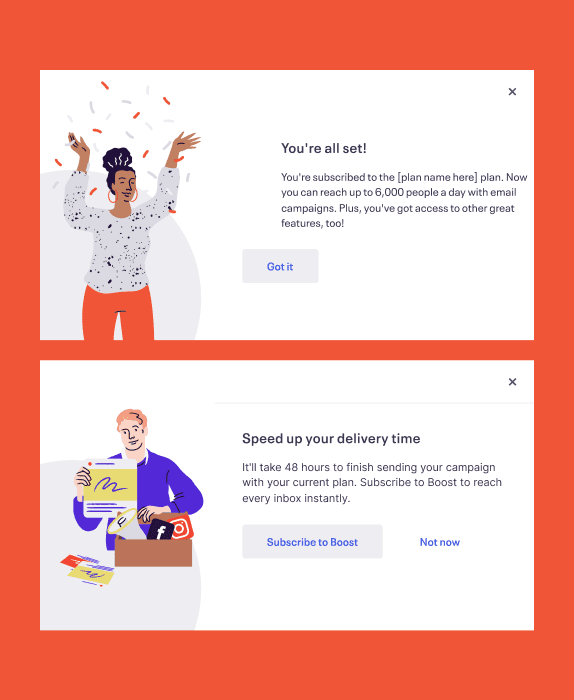
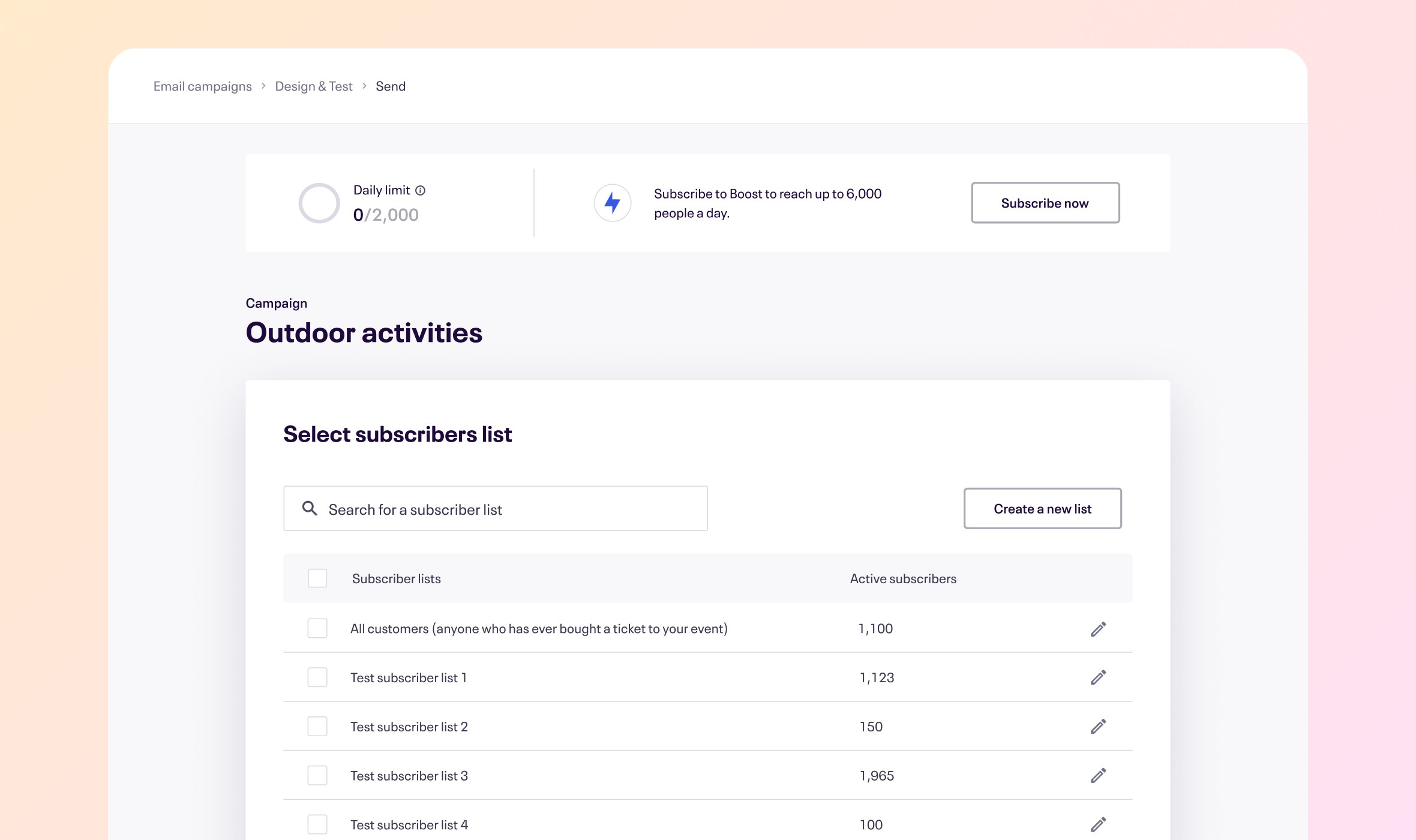
We designed an upgrade path that made invisible value visible. The solution centered on a banner component strategically placed in the campaign creation flow. When creators selected subscriber lists, they'd see their daily limit progress: "0/2,000" with a clear message: "Send up to 6,000 emails a day with Boost+."
The design prioritized transparency over hidden friction. Instead of letting users discover the limit only when blocked from sending, we surfaced it early—during list selection—so they could make informed decisions. If their campaign exceeded 2,000 recipients, the system showed exactly how many days it would take to complete: "Your campaign will be sent to 10,000 subscribers over the course of 5 days."
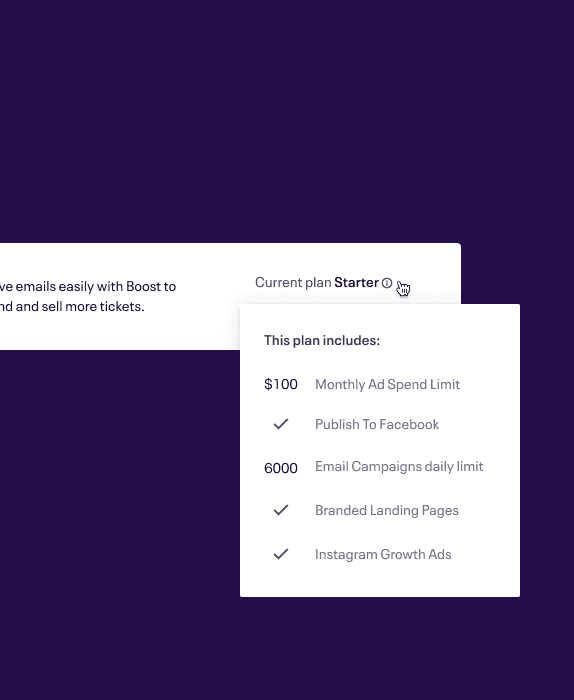
The upgrade CTA was straightforward: "Increase your limit" linked directly to Boost subscription plans. The pricing was competitive: $15/month for Starter (6,000 daily emails), compared to Mailchimp's $14.99 (6,000 monthly) or Constant Contact's $25 (500 contacts). We weren't just selling more emails—we were communicating that Eventbrite already offered better value than competitors, and premium unlocked even more.
Making value visible
The results
Within three months of launch, the feature converted 35% of free users who encountered the daily limit to paid Boost subscriptions. These weren't random upgrades—they were engaged creators with real audiences, exactly the customers Boost needed to retain.
The feature contributed significantly to Boost's $2.4M revenue target. More importantly, it became one of the top conversion drivers for premium subscriptions for Boost, proving that strategic friction points—when designed transparently—can accelerate monetization without damaging user experience.
Creators who previously chunked campaigns manually or considered leaving Eventbrite now had a clear path forward. The upgrade didn't feel like a paywall; it felt like unlocking capacity they already needed. By surfacing the limit early and showing exactly what the premium subscription offered, we turned a frustration point into a value proposition.
The best monetization design doesn't create new friction—it makes existing friction visible and offers a clear way through.
More Projects
Product Design
Eventbrite Boost
I designed the daily limit upgrade feature that converted 35% of existing and new free users to paid subscribers and contributed to $2.4M in revenue within the first three months of launch.
Year :
2021
Industry :
Events
Client :
Eventbrite
Project Duration :
3 months
Client
Eventbrite is a global ticketing and marketing platform for events processing millions of transactions annually. Boost was their marketing automation suite designed to turn event creators into effective marketers.
Challenge
Eventbrite Boost offered free email campaigns with a 2,000 emails-per-day limit. For event creators with small audiences, this was more than enough. But creators with larger databases—10,000, 20,000, even 26,000 contacts—constantly hit this ceiling.
These creators had two choices: manually chunk their campaigns into multiple 2,000-email batches over several days, or leave Eventbrite entirely and use Mailchimp or Constant Contact. Both options created friction. Manual chunking was tedious and error-prone. External tools meant exporting lists, managing multiple platforms, and losing the integrated experience Boost promised.
Here's the irony: Eventbrite was already giving away more for free than most competitors. Mailchimp had no daily limit for paid plans but charged from day one. HubSpot offered 5,000 emails. Sendinblue had unlimited daily sends but charged $25/month. Eventbrite gave 2,000/day for free—a generous offer—but nobody knew to appreciate it because it was invisible until you hit the limit.
The business problem was clear: free users weren't converting to Boost premium subscriptions. The email tool was valuable but didn't create enough perceived value to justify upgrading. Meanwhile, the most engaged users—those with large audiences who actually needed premium features—were the ones hitting friction and considering alternatives.
The opportunity: turn that friction point into a conversion moment.
Solution
In collaboration with the PM, we identified the daily limit as a strategic monetization opportunity. Users hitting the 2,000 email cap were signaling high engagement and real need—exactly the moment when upgrade offers convert best.
We designed an upgrade path that made invisible value visible. The solution centered on a banner component strategically placed in the campaign creation flow. When creators selected subscriber lists, they'd see their daily limit progress: "0/2,000" with a clear message: "Send up to 6,000 emails a day with Boost+."
The design prioritized transparency over hidden friction. Instead of letting users discover the limit only when blocked from sending, we surfaced it early—during list selection—so they could make informed decisions. If their campaign exceeded 2,000 recipients, the system showed exactly how many days it would take to complete: "Your campaign will be sent to 10,000 subscribers over the course of 5 days."
The upgrade CTA was straightforward: "Increase your limit" linked directly to Boost subscription plans. The pricing was competitive: $15/month for Starter (6,000 daily emails), compared to Mailchimp's $14.99 (6,000 monthly) or Constant Contact's $25 (500 contacts). We weren't just selling more emails—we were communicating that Eventbrite already offered better value than competitors, and premium unlocked even more.
Making value visible
The results
Within three months of launch, the feature converted 35% of free users who encountered the daily limit to paid Boost subscriptions. These weren't random upgrades—they were engaged creators with real audiences, exactly the customers Boost needed to retain.
The feature contributed significantly to Boost's $2.4M revenue target. More importantly, it became one of the top conversion drivers for premium subscriptions for Boost, proving that strategic friction points—when designed transparently—can accelerate monetization without damaging user experience.
Creators who previously chunked campaigns manually or considered leaving Eventbrite now had a clear path forward. The upgrade didn't feel like a paywall; it felt like unlocking capacity they already needed. By surfacing the limit early and showing exactly what the premium subscription offered, we turned a frustration point into a value proposition.
The best monetization design doesn't create new friction—it makes existing friction visible and offers a clear way through.
More Projects
Product Design
Eventbrite Boost
I designed the daily limit upgrade feature that converted 35% of existing and new free users to paid subscribers and contributed to $2.4M in revenue within the first three months of launch.
Year :
2021
Industry :
Events
Client :
Eventbrite
Project Duration :
3 months
Client
Eventbrite is a global ticketing and marketing platform for events processing millions of transactions annually. Boost was their marketing automation suite designed to turn event creators into effective marketers.
Challenge
Eventbrite Boost offered free email campaigns with a 2,000 emails-per-day limit. For event creators with small audiences, this was more than enough. But creators with larger databases—10,000, 20,000, even 26,000 contacts—constantly hit this ceiling.
These creators had two choices: manually chunk their campaigns into multiple 2,000-email batches over several days, or leave Eventbrite entirely and use Mailchimp or Constant Contact. Both options created friction. Manual chunking was tedious and error-prone. External tools meant exporting lists, managing multiple platforms, and losing the integrated experience Boost promised.
Here's the irony: Eventbrite was already giving away more for free than most competitors. Mailchimp had no daily limit for paid plans but charged from day one. HubSpot offered 5,000 emails. Sendinblue had unlimited daily sends but charged $25/month. Eventbrite gave 2,000/day for free—a generous offer—but nobody knew to appreciate it because it was invisible until you hit the limit.
The business problem was clear: free users weren't converting to Boost premium subscriptions. The email tool was valuable but didn't create enough perceived value to justify upgrading. Meanwhile, the most engaged users—those with large audiences who actually needed premium features—were the ones hitting friction and considering alternatives.
The opportunity: turn that friction point into a conversion moment.
Solution
In collaboration with the PM, we identified the daily limit as a strategic monetization opportunity. Users hitting the 2,000 email cap were signaling high engagement and real need—exactly the moment when upgrade offers convert best.
We designed an upgrade path that made invisible value visible. The solution centered on a banner component strategically placed in the campaign creation flow. When creators selected subscriber lists, they'd see their daily limit progress: "0/2,000" with a clear message: "Send up to 6,000 emails a day with Boost+."
The design prioritized transparency over hidden friction. Instead of letting users discover the limit only when blocked from sending, we surfaced it early—during list selection—so they could make informed decisions. If their campaign exceeded 2,000 recipients, the system showed exactly how many days it would take to complete: "Your campaign will be sent to 10,000 subscribers over the course of 5 days."
The upgrade CTA was straightforward: "Increase your limit" linked directly to Boost subscription plans. The pricing was competitive: $15/month for Starter (6,000 daily emails), compared to Mailchimp's $14.99 (6,000 monthly) or Constant Contact's $25 (500 contacts). We weren't just selling more emails—we were communicating that Eventbrite already offered better value than competitors, and premium unlocked even more.
Making value visible
The results
Within three months of launch, the feature converted 35% of free users who encountered the daily limit to paid Boost subscriptions. These weren't random upgrades—they were engaged creators with real audiences, exactly the customers Boost needed to retain.
The feature contributed significantly to Boost's $2.4M revenue target. More importantly, it became one of the top conversion drivers for premium subscriptions for Boost, proving that strategic friction points—when designed transparently—can accelerate monetization without damaging user experience.
Creators who previously chunked campaigns manually or considered leaving Eventbrite now had a clear path forward. The upgrade didn't feel like a paywall; it felt like unlocking capacity they already needed. By surfacing the limit early and showing exactly what the premium subscription offered, we turned a frustration point into a value proposition.
The best monetization design doesn't create new friction—it makes existing friction visible and offers a clear way through.