Product Design
Track
I designed the complete mobile app that converted 7 disconnected tools (Word, Excel, WhatsApp, email, Drive) into an integrated solution for on-site team management, resulting in the first software of its kind in Latin America.
Year :
2024
Industry :
Construction
Client :
Coef Digital
Project Duration :
3 months
Client
COEF is a leading construction company in Mendoza, Argentina, specializing in clinical buildings, housing, offices, and commercial spaces. With deep knowledge of construction processes, they position themselves as a fundamental part of the province's development.
Challenge
COEF's administration managed construction crews (masons, carpenters, electricians, plumbers, ironworkers, painters, heavy machinery operators) using a fragmented ecosystem of tools: Word for documents, Excel for tracking, WhatsApp for urgent communication, email for formalities, and Drive for insurance policies.
Each tool served a purpose, but together they created chaos. A site supervisor requested materials via WhatsApp, the admin logged it in Excel, it was confirmed by email, and nobody was sure which was the updated version. Insurance policies lived in Drive with no connection to active projects. Communication was reactive, not proactive. Processes were slow because each step required switching platforms.
The problem was amplified by construction's nature: field teams without constant laptop access, need for quick responses, multiple simultaneous projects, and clear hierarchies (administration, supervisors, workers) requiring different access levels and functionality.
COEF needed a solution that unified everything but also worked for three completely different user types, with different technical skills and different needs in the field vs office. That was the beginning of Track - The platform that manages construction personnel.

Solution
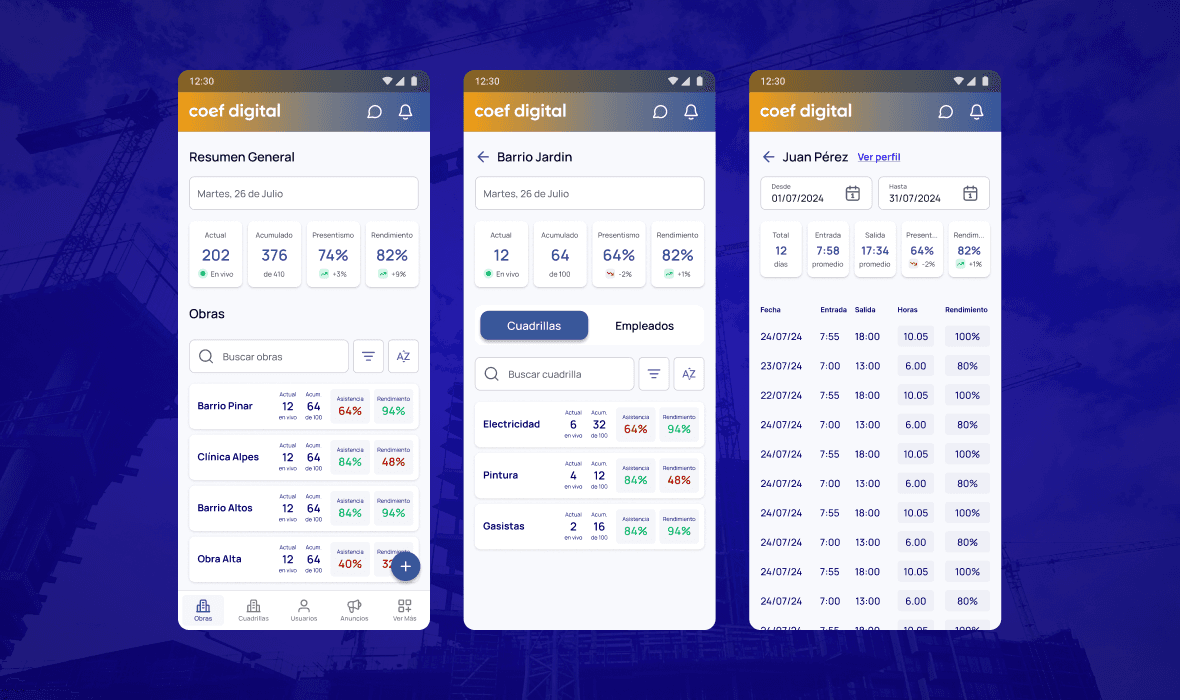
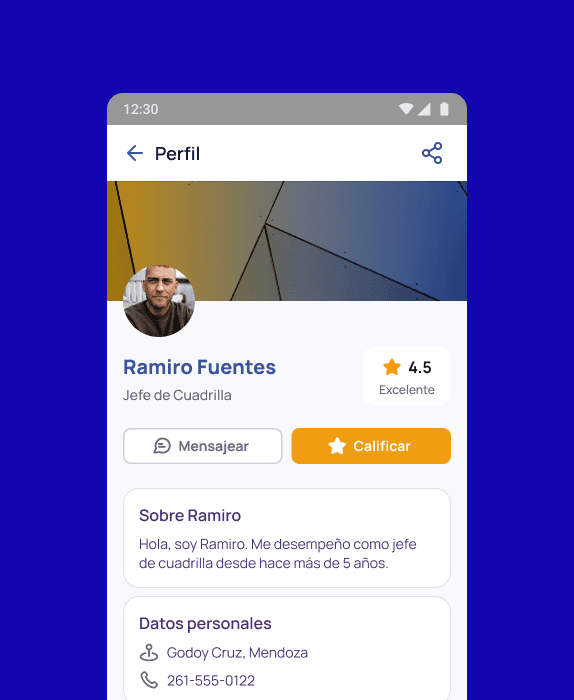
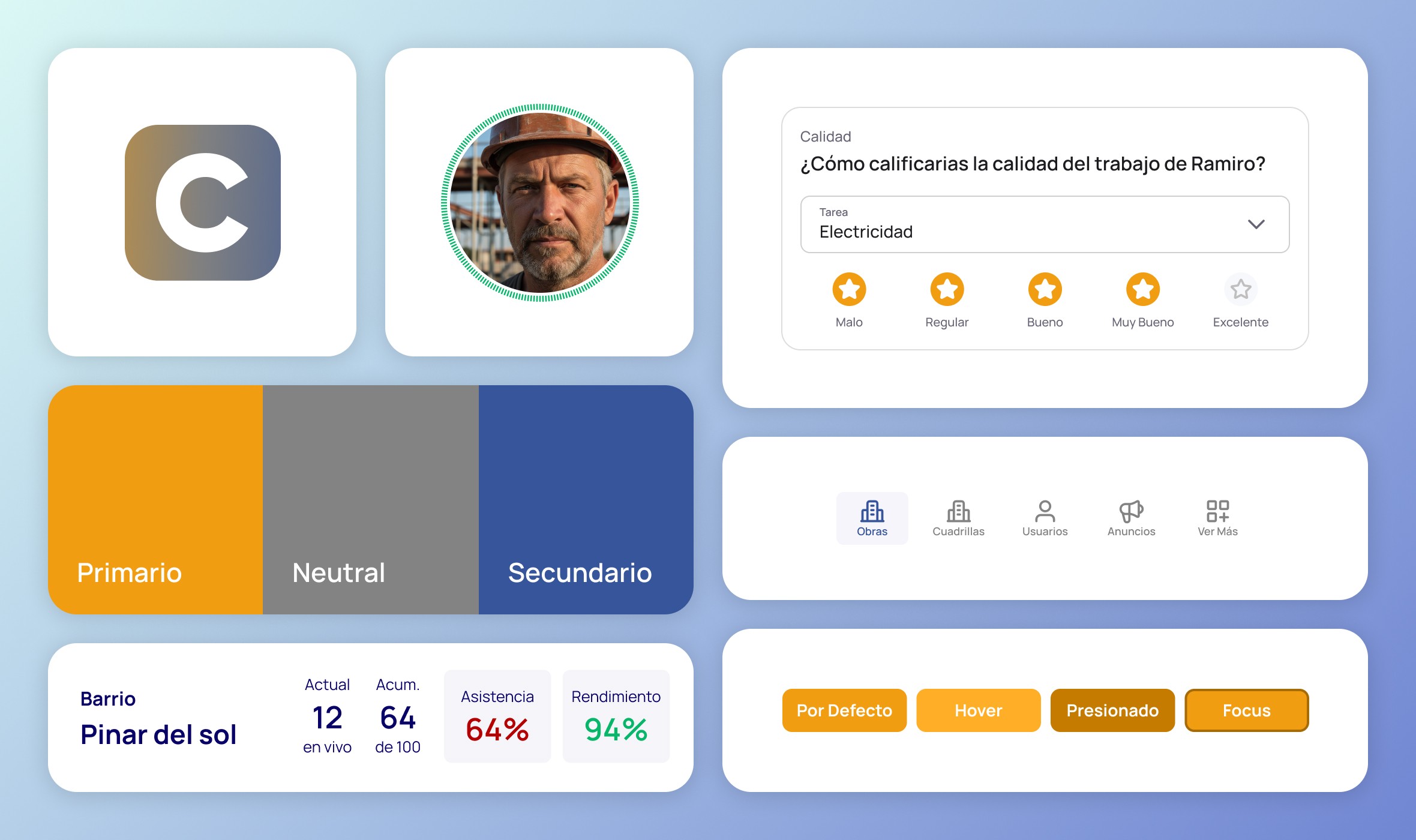
I led the design for their mobile/tablet app with a well-differentiated 3-role architecture. Super Admin sees a complete overview of all projects, teams, resources, and finances. Employer (administration and supervisors) manages their specific crews, assigns tasks, approves requests, and tracks progress. Employees (workers) see only their assigned tasks, report completion, and request resources when needed.
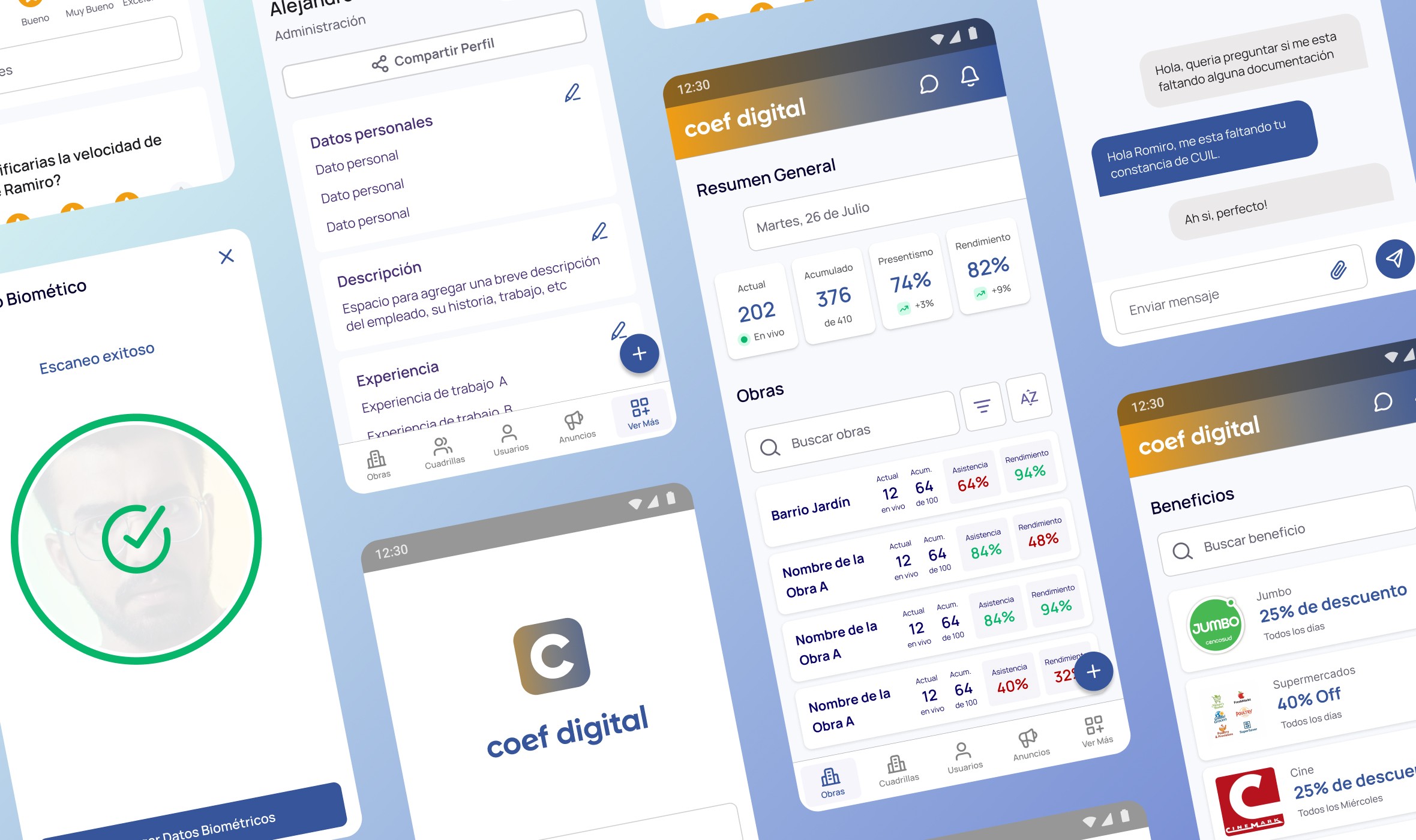
The information architecture prioritized extreme simplicity for field workers—large buttons, linear flows, visual confirmations—while giving analytical depth for administration. A supervisor can see on one screen which crew is on which project, what materials they need, and which tasks are delayed.
The design contemplated on-site reality: intermittent signal, dirty hands, glove use, and direct sunlight. Therefore, an offline-first approach with automatic sync when connected, high contrast for outdoor readability, and large buttons for quick interaction.
All documents, communications, and processes that previously lived in 7 different tools are now centralized. Insurance policies are linked to specific projects. Material requests are approved with a tap, not email chains. Progress tracking is automatic, not manual, in Excel.
The strategic objective: design as a white-label product for commercialization beyond COEF. This implied modular design system, permission configurability, and scalable architecture.
From chaos to clarity
The results
The MVP was beta-tested with 1 administrative person and 3 complete crews (supervisors + multiple workers of different specialties). Field adoption was immediate—workers preferred the app to WhatsApp chaos because they knew exactly what to do each day without having to confirm across multiple channels.
Site supervisors recovered the daily hours previously spent coordinating between tools. Seeing everything centralized eliminated the "detective work" of searching for information across Drive, Excel, WhatsApp, and email. Decisions accelerated because information was available in real-time.
Subsequent software development based on our designs resulted in the first system of its kind in Latin America, according to press coverage in February 2025. COEF not only solved its internal problem—it created a commercializable product for the entire regional construction industry.
The unification of fragmented tools demonstrated that the problem wasn't a lack of technology—there was too much. The solution was intelligent consolidation with UX adapted to field realities.
Sometimes the best design isn't adding features—it's eliminating friction between the ones that already exist.
More Projects
Product Design
Track
I designed the complete mobile app that converted 7 disconnected tools (Word, Excel, WhatsApp, email, Drive) into an integrated solution for on-site team management, resulting in the first software of its kind in Latin America.
Year :
2024
Industry :
Construction
Client :
Coef Digital
Project Duration :
3 months
Client
COEF is a leading construction company in Mendoza, Argentina, specializing in clinical buildings, housing, offices, and commercial spaces. With deep knowledge of construction processes, they position themselves as a fundamental part of the province's development.
Challenge
COEF's administration managed construction crews (masons, carpenters, electricians, plumbers, ironworkers, painters, heavy machinery operators) using a fragmented ecosystem of tools: Word for documents, Excel for tracking, WhatsApp for urgent communication, email for formalities, and Drive for insurance policies.
Each tool served a purpose, but together they created chaos. A site supervisor requested materials via WhatsApp, the admin logged it in Excel, it was confirmed by email, and nobody was sure which was the updated version. Insurance policies lived in Drive with no connection to active projects. Communication was reactive, not proactive. Processes were slow because each step required switching platforms.
The problem was amplified by construction's nature: field teams without constant laptop access, need for quick responses, multiple simultaneous projects, and clear hierarchies (administration, supervisors, workers) requiring different access levels and functionality.
COEF needed a solution that unified everything but also worked for three completely different user types, with different technical skills and different needs in the field vs office. That was the beginning of Track - The platform that manages construction personnel.
Solution
I led the design for their mobile/tablet app with a well-differentiated 3-role architecture. Super Admin sees a complete overview of all projects, teams, resources, and finances. Employer (administration and supervisors) manages their specific crews, assigns tasks, approves requests, and tracks progress. Employees (workers) see only their assigned tasks, report completion, and request resources when needed.
The information architecture prioritized extreme simplicity for field workers—large buttons, linear flows, visual confirmations—while giving analytical depth for administration. A supervisor can see on one screen which crew is on which project, what materials they need, and which tasks are delayed.
The design contemplated on-site reality: intermittent signal, dirty hands, glove use, and direct sunlight. Therefore, an offline-first approach with automatic sync when connected, high contrast for outdoor readability, and large buttons for quick interaction.
All documents, communications, and processes that previously lived in 7 different tools are now centralized. Insurance policies are linked to specific projects. Material requests are approved with a tap, not email chains. Progress tracking is automatic, not manual, in Excel.
The strategic objective: design as a white-label product for commercialization beyond COEF. This implied modular design system, permission configurability, and scalable architecture.
From chaos to clarity
The results
The MVP was beta-tested with 1 administrative person and 3 complete crews (supervisors + multiple workers of different specialties). Field adoption was immediate—workers preferred the app to WhatsApp chaos because they knew exactly what to do each day without having to confirm across multiple channels.
Site supervisors recovered the daily hours previously spent coordinating between tools. Seeing everything centralized eliminated the "detective work" of searching for information across Drive, Excel, WhatsApp, and email. Decisions accelerated because information was available in real-time.
Subsequent software development based on our designs resulted in the first system of its kind in Latin America, according to press coverage in February 2025. COEF not only solved its internal problem—it created a commercializable product for the entire regional construction industry.
The unification of fragmented tools demonstrated that the problem wasn't a lack of technology—there was too much. The solution was intelligent consolidation with UX adapted to field realities.
Sometimes the best design isn't adding features—it's eliminating friction between the ones that already exist.
More Projects
Product Design
Track
I designed the complete mobile app that converted 7 disconnected tools (Word, Excel, WhatsApp, email, Drive) into an integrated solution for on-site team management, resulting in the first software of its kind in Latin America.
Year :
2024
Industry :
Construction
Client :
Coef Digital
Project Duration :
3 months
Client
COEF is a leading construction company in Mendoza, Argentina, specializing in clinical buildings, housing, offices, and commercial spaces. With deep knowledge of construction processes, they position themselves as a fundamental part of the province's development.
Challenge
COEF's administration managed construction crews (masons, carpenters, electricians, plumbers, ironworkers, painters, heavy machinery operators) using a fragmented ecosystem of tools: Word for documents, Excel for tracking, WhatsApp for urgent communication, email for formalities, and Drive for insurance policies.
Each tool served a purpose, but together they created chaos. A site supervisor requested materials via WhatsApp, the admin logged it in Excel, it was confirmed by email, and nobody was sure which was the updated version. Insurance policies lived in Drive with no connection to active projects. Communication was reactive, not proactive. Processes were slow because each step required switching platforms.
The problem was amplified by construction's nature: field teams without constant laptop access, need for quick responses, multiple simultaneous projects, and clear hierarchies (administration, supervisors, workers) requiring different access levels and functionality.
COEF needed a solution that unified everything but also worked for three completely different user types, with different technical skills and different needs in the field vs office. That was the beginning of Track - The platform that manages construction personnel.
Solution
I led the design for their mobile/tablet app with a well-differentiated 3-role architecture. Super Admin sees a complete overview of all projects, teams, resources, and finances. Employer (administration and supervisors) manages their specific crews, assigns tasks, approves requests, and tracks progress. Employees (workers) see only their assigned tasks, report completion, and request resources when needed.
The information architecture prioritized extreme simplicity for field workers—large buttons, linear flows, visual confirmations—while giving analytical depth for administration. A supervisor can see on one screen which crew is on which project, what materials they need, and which tasks are delayed.
The design contemplated on-site reality: intermittent signal, dirty hands, glove use, and direct sunlight. Therefore, an offline-first approach with automatic sync when connected, high contrast for outdoor readability, and large buttons for quick interaction.
All documents, communications, and processes that previously lived in 7 different tools are now centralized. Insurance policies are linked to specific projects. Material requests are approved with a tap, not email chains. Progress tracking is automatic, not manual, in Excel.
The strategic objective: design as a white-label product for commercialization beyond COEF. This implied modular design system, permission configurability, and scalable architecture.
From chaos to clarity
The results
The MVP was beta-tested with 1 administrative person and 3 complete crews (supervisors + multiple workers of different specialties). Field adoption was immediate—workers preferred the app to WhatsApp chaos because they knew exactly what to do each day without having to confirm across multiple channels.
Site supervisors recovered the daily hours previously spent coordinating between tools. Seeing everything centralized eliminated the "detective work" of searching for information across Drive, Excel, WhatsApp, and email. Decisions accelerated because information was available in real-time.
Subsequent software development based on our designs resulted in the first system of its kind in Latin America, according to press coverage in February 2025. COEF not only solved its internal problem—it created a commercializable product for the entire regional construction industry.
The unification of fragmented tools demonstrated that the problem wasn't a lack of technology—there was too much. The solution was intelligent consolidation with UX adapted to field realities.
Sometimes the best design isn't adding features—it's eliminating friction between the ones that already exist.